

AI SEO Agent vs AI SEO Tool: What’s the Difference and Which One Does Your Business Need?
AI is changing how businesses approach SEO. What used to require separate tools, spreadsheets, manual audits, and disconnected content workflows can now be supported by AI-powered systems that help teams research, plan, optimize, publish, and monitor SEO work more efficiently.
But there is an important difference between an AI SEO tool and an AI SEO agent. An AI SEO tool usually helps with specific tasks, such as keyword research, content optimization, site audits, or reporting. An AI SEO agent is more workflow-driven. It helps connect multiple SEO tasks into an ongoing process, recommends what to do next, and supports continuous optimization over time.
In this guide, you’ll learn the difference between AI SEO agents and AI SEO tools, when each one makes sense, how they support small businesses and agencies, and how to choose the right approach for your SEO growth.
Quick Answer
An AI SEO tool helps with specific SEO tasks like keyword research, content briefs, audits, or reporting. An AI SEO agent supports a broader SEO workflow by helping plan, prioritize, execute, and monitor SEO actions over time. Businesses that only need help with one task may choose a tool. Teams that need continuous SEO support may benefit more from an AI SEO agent.
For a broader view of AI SEO, GEO, AI Overviews, and automation workflows, start with the AI SEO Hub.
AI SEO Agent vs AI SEO Tool: Quick Comparison
The easiest way to understand the difference is to compare their role inside the SEO workflow. A tool usually helps you complete a specific task. An agent helps you connect tasks and move from insight to action.
| Comparison Area | AI SEO Tool | AI SEO Agent |
|---|---|---|
| Main Role | Helps with specific SEO tasks. | Supports an ongoing SEO workflow. |
| Best For | Keyword research, content briefs, audits, or reporting. | Planning, prioritizing, executing, and monitoring SEO actions over time. |
| User Effort | The user usually decides what to do next. | The agent helps recommend next steps based on goals and data. |
| Workflow | Often focused on one task or feature. | Connects multiple tasks into a repeatable SEO process. |
| Automation Level | Partial automation. | More continuous and workflow-driven automation. |
| Best Fit | Teams that need help with a specific SEO function. | Teams that want a smarter SEO system, not just another dashboard. |
What Is an AI SEO Tool?
An AI SEO tool is software that uses artificial intelligence to help with one or more SEO tasks. These tools may help teams research keywords, generate content briefs, analyze competitors, audit websites, optimize pages, monitor rankings, or produce SEO reports.
AI SEO tools are useful because they reduce manual work and help teams make faster decisions. Instead of reviewing every page, keyword, or technical issue manually, a tool can analyze data and surface recommendations.
Common AI SEO tool features
- Keyword research and keyword clustering.
- Search intent analysis.
- Content brief generation.
- On-page optimization suggestions.
- Technical SEO audits.
- Internal linking suggestions.
- Rank tracking and reporting.
- Meta title and description recommendations.
- Content scoring and readability checks.
If you are comparing platforms, read our guide to the best AI SEO tools for small businesses and agencies.
When an AI SEO tool is enough
An AI SEO tool may be enough when your team already has a clear strategy and only needs help with execution. For example, if you already know which pages to optimize and only need content scoring, keyword research, or audit data, a tool can be a practical choice.
AI SEO tools work well when you need:
- A faster way to create content briefs.
- Help with on-page optimization.
- Technical audit data.
- Keyword and competitor research.
- Basic SEO reporting.
- Support for specific recurring tasks.
What Is an AI SEO Agent?
An AI SEO agent is a more workflow-oriented system. Instead of only giving isolated recommendations, an AI SEO agent helps connect SEO goals, data, priorities, tasks, and performance monitoring into a continuous process.
A useful AI SEO agent does not simply generate content. It helps answer a more important question:
The Real Question
What should we do next to improve SEO performance, and why?
An AI SEO agent can support planning, prioritization, content workflows, technical SEO checks, internal linking, structured data, publishing support, and performance monitoring.
Common AI SEO agent capabilities
- Build SEO roadmaps based on goals and website status.
- Prioritize technical SEO fixes by impact.
- Recommend content topics based on opportunity and intent.
- Connect articles into topic clusters.
- Suggest internal links between related pages.
- Identify pages that need updates or consolidation.
- Support AI SEO and GEO workflows.
- Monitor performance and recommend next actions.
GEO works best when it is connected to an AI SEO workflow, not treated as a one-time content task. Learn more in our guide to Generative Engine Optimization.
The Real Difference: Task Support vs Workflow Support
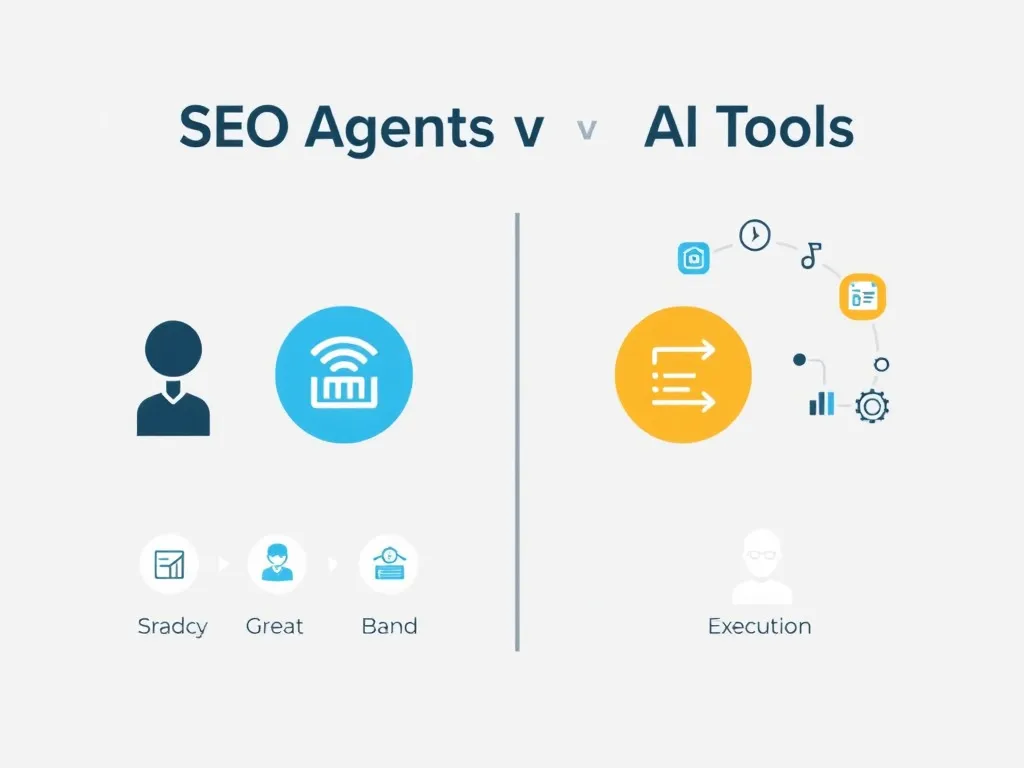
The biggest difference between an AI SEO tool and an AI SEO agent is not the use of AI. Both can use AI. The real difference is how they fit into your SEO process.
An AI SEO tool usually helps with a specific function. For example, it may help you write a better title, find keywords, score content, or audit a page. But the user still has to decide how each task fits into the bigger SEO strategy.
An AI SEO agent is designed to help connect these tasks. It can help you move from research to prioritization, from prioritization to content planning, from content planning to technical optimization, and from publishing to monitoring.
AI SEO tool example
You enter a keyword, and the tool gives you related keywords, content suggestions, or a content score.
AI SEO agent example
The agent reviews your website, identifies that technical SEO issues are blocking indexing, recommends which pages to fix first, suggests internal links, creates content briefs for missing topics, and monitors performance after updates.
AI SEO agents are becoming more important as search shifts toward ChatGPT, Perplexity, and Google AI Overviews. Read this guide on how to optimize your website for ChatGPT, Perplexity, and Google AI Overviews.
When Should You Choose an AI SEO Tool?
Choose an AI SEO tool when you need help with a specific part of SEO and already have someone who can make strategic decisions.
An AI SEO tool is a good fit when:
- You already know your SEO priorities.
- You need faster keyword research.
- You want help creating content briefs.
- You need on-page optimization suggestions.
- You want to monitor rankings or traffic.
- You need technical audit data.
- Your team can interpret recommendations and execute them.
For example, a content team may use an AI SEO tool to optimize articles against search intent. An agency may use a tool to generate reports or audit multiple client websites. A small business may use a tool to identify basic technical issues and content opportunities.
When Should You Choose an AI SEO Agent?
Choose an AI SEO agent when you need help connecting SEO tasks into a repeatable workflow. This is especially useful when your team does not only need data, but also needs prioritization, guidance, and execution support.
An AI SEO agent is a good fit when:
- You are not sure what SEO work to prioritize first.
- Your website has many content and technical issues.
- You need a repeatable SEO workflow.
- You want to connect research, content, technical SEO, and publishing.
- You are managing multiple websites or clients.
- You want ongoing recommendations, not one-time reports.
- You need to scale SEO without building a large internal team.
A useful AI SEO agent should also support technical SEO, indexing checks, structured data, internal linking, and content workflows.
AI SEO Agent vs AI SEO Tool for Small Businesses
Small businesses often have limited time, limited budgets, and small teams. This makes the choice between an AI SEO tool and an AI SEO agent especially important.
Small businesses may need an AI SEO tool when:
- They only need basic keyword research.
- They publish a small number of articles.
- They have someone who understands SEO strategy.
- They mainly need help with writing or on-page improvements.
Small businesses may need an AI SEO agent when:
- They do not have a full SEO team.
- They need help deciding what to do next.
- They want to reduce manual SEO work.
- They need content, technical SEO, and monitoring connected.
- They want a system that supports growth over time.
For many small businesses, the best path is to start with a practical SEO workflow system instead of collecting too many disconnected tools.
AI SEO Agent vs AI SEO Tool for Agencies
Agencies usually need speed, consistency, reporting, and repeatable workflows across multiple clients. This makes AI SEO agents especially valuable when the agency wants to scale without reducing quality.
Agencies may need AI SEO tools for:
- Client reporting.
- Rank tracking.
- Technical audits.
- Keyword research.
- Content optimization.
- Competitor analysis.
Agencies may need AI SEO agents for:
- Managing SEO workflows across multiple clients.
- Prioritizing tasks by impact.
- Creating consistent content strategies.
- Monitoring changes after updates.
- Connecting technical fixes with content planning.
- Reducing dependency on manual project management.
For agencies, the value of an AI SEO agent is not only automation. It is workflow control. A strong agent-style system helps keep strategy, execution, and monitoring connected across multiple accounts.
How AI SEO Agents and Tools Work Together
In many cases, the best strategy is not choosing between an AI SEO agent and an AI SEO tool. The best strategy is combining both.
A tool can collect data, run audits, score content, and monitor rankings. An agent can help interpret the data, prioritize the work, and recommend the next action based on business goals.
A combined workflow might look like this:
- The tool audits the website and identifies technical SEO issues.
- The agent prioritizes issues based on potential impact.
- The tool helps generate content briefs and optimization suggestions.
- The agent connects content tasks into a topic cluster strategy.
- The tool monitors rankings, clicks, and indexing changes.
- The agent recommends the next optimization cycle.
The best AI SEO workflow connects research, technical fixes, content planning, publishing, and monitoring.
Where Hunnt AI Fits
Hunnt AI is designed for teams that need more than isolated SEO suggestions. It helps connect SEO research, technical SEO insights, content planning, optimization, and publishing support into a more practical AI SEO workflow.
Instead of treating SEO as separate tasks, Hunnt AI helps teams think in systems:
- What should we optimize first?
- Which content opportunities matter most?
- Which technical SEO issues are blocking growth?
- Which pages need stronger internal links?
- Which topics need hub pages or supporting content?
- Which updates should we monitor after publishing?
This makes Hunnt AI especially relevant for businesses and agencies that want a more connected SEO process, not just another dashboard or content generator.
Common Mistakes When Choosing Between an AI SEO Agent and a Tool
Many teams choose SEO software based on hype, features, or pricing without understanding the workflow they actually need. This often leads to unused tools, generic AI content, or recommendations that never get implemented.
Avoid these mistakes:
- Choosing a tool without a workflow: Data is useful only when your team knows how to act on it.
- Expecting AI to replace strategy: AI can support strategy, but business judgment still matters.
- Using AI only for content generation: SEO also needs technical health, internal links, schema, and monitoring.
- Ignoring technical SEO: Content cannot perform if pages are not crawlable or indexable.
- Publishing too much generic content: AI-assisted content still needs originality, examples, and expertise.
- Skipping measurement: Track impressions, clicks, rankings, conversions, and indexing changes.
- Buying multiple tools without integration: A disconnected stack can create more work instead of less.
Decision Framework: Which One Does Your Business Need?
Use this simple framework to decide whether your business needs an AI SEO tool, an AI SEO agent, or both.
| Your Situation | Best Choice |
|---|---|
| You need keyword data, audits, or content scoring. | AI SEO Tool |
| You already have an SEO strategist and only need execution support. | AI SEO Tool |
| You are not sure what SEO tasks to prioritize. | AI SEO Agent |
| You need to connect technical SEO, content, publishing, and monitoring. | AI SEO Agent |
| You manage multiple websites or client accounts. | AI SEO Agent + AI SEO Tools |
| You want continuous optimization, not one-time reports. | AI SEO Agent |
AI SEO Agent vs AI SEO Tool FAQs
What is an AI SEO agent?
An AI SEO agent is a workflow-oriented AI system that helps plan, prioritize, execute, and monitor SEO actions over time. It can support content planning, technical SEO, internal linking, structured data, and performance monitoring.
What is an AI SEO tool?
An AI SEO tool is software that helps with specific SEO tasks such as keyword research, content optimization, technical audits, rank tracking, internal linking suggestions, or reporting.
Is an AI SEO agent better than an AI SEO tool?
Not always. An AI SEO tool is useful for specific tasks. An AI SEO agent is more useful when you need a connected workflow and ongoing recommendations. The best choice depends on your team’s needs, goals, and SEO maturity.
Can an AI SEO agent replace an SEO specialist?
No. An AI SEO agent can support research, planning, prioritization, and workflow execution, but human judgment is still important for strategy, brand positioning, accuracy, and business decisions.
Do small businesses need an AI SEO agent?
Small businesses may benefit from an AI SEO agent if they do not have a full SEO team and need help deciding what to do next. If they only need keyword research or content suggestions, an AI SEO tool may be enough.
Do agencies need AI SEO agents?
Agencies can benefit from AI SEO agents because they need repeatable workflows, prioritization, monitoring, and consistency across multiple clients. Tools help execute tasks, while agents help connect strategy and action.
How does an AI SEO agent support GEO?
An AI SEO agent can support GEO by helping structure content for AI-generated answers, connect topic clusters, improve entity clarity, add schema, and monitor AI-related search visibility.
Conclusion: Choose the System That Fits Your SEO Goals
The difference between an AI SEO agent and an AI SEO tool comes down to workflow. A tool helps with specific tasks. An agent helps connect those tasks into a smarter, more continuous SEO process.
If your team already has a strong SEO strategy and only needs help with execution, an AI SEO tool may be enough. If your team needs help deciding what to prioritize, connecting technical SEO with content, building topic clusters, and monitoring performance over time, an AI SEO agent may be the better fit.
For many growing businesses and agencies, the strongest approach is a combination: tools for execution, and an agent-style workflow for strategy, prioritization, and continuous improvement.
To continue building your AI SEO strategy, explore the AI SEO Hub, compare the best AI SEO tools, or see how Hunnt AI helps teams improve SEO workflows.