
SEO is not dead. But SEO that depends only on keywords, generic content, manual guesswork, and isolated blog publishing is becoming less effective.
AI search is changing how people discover information. Users are no longer relying only on traditional blue links in Google. They now receive answers through Google AI Overviews, ChatGPT, Perplexity, and other AI-driven search experiences. This means businesses need to rethink how they create, structure, and optimize content.
Traditional SEO still matters, but it is evolving. The future of SEO is not traditional SEO versus AI search. It is a connected system that combines technical SEO, helpful content, structured data, entity clarity, GEO, AI SEO workflows, and automation.
Quick Answer
SEO is not dead. Traditional SEO fundamentals such as crawlability, indexing, content quality, internal links, technical SEO, and authority still matter. What is changing is how search visibility works. Businesses now need to optimize for traditional search results, Google AI Overviews, ChatGPT, Perplexity, and AI-generated answers.
For a broader strategy around AI search visibility, start with the AI SEO Hub, which connects AI SEO, GEO, AI Overviews, SEO automation, and technical SEO into one practical framework.
Is SEO Really Dead?
No, SEO is not dead. People still search. Search engines still need to discover, crawl, understand, and rank content. Businesses still need visibility when potential customers search for products, services, answers, comparisons, and solutions.
What is changing is the way search results are presented and how users interact with information. AI-generated summaries, conversational answers, featured snippets, rich results, and answer engines are reducing the gap between search and answer.
This means the question is not whether SEO is dead. The better question is:
The Real Question
Is your SEO strategy ready for AI search, answer engines, and more structured search experiences?
What Parts of Traditional SEO Are Becoming Less Effective?
Some old SEO tactics are becoming weaker because search engines and AI systems are better at understanding intent, context, quality, and usefulness.
1. Keyword stuffing
Repeating keywords without adding value is no longer a serious strategy. Search systems can understand related terms, entities, questions, and user intent. Content should answer the query clearly, not repeat the phrase unnaturally.
2. Generic AI content
Publishing large amounts of generic content does not build authority. AI-assisted content still needs human review, examples, expertise, structure, accuracy, and a clear reason to exist.
3. Random blog publishing
Publishing disconnected articles without topic clusters, internal links, or a strategic content map makes it harder for search engines and AI systems to understand your authority.
4. Ignoring technical SEO
If your pages are slow, blocked, broken, not indexed, or poorly structured, content quality alone may not be enough. Technical SEO is becoming more important, not less.
5. Writing only for blue links
Modern content should be prepared for traditional rankings, featured snippets, AI Overviews, answer engines, and conversational search. That requires clearer answers, better structure, schema, and entity signals.
What Parts of SEO Are More Important Than Ever?
AI search does not remove the need for SEO fundamentals. It makes the strongest fundamentals even more important.
| SEO Area | Why It Matters More Now |
|---|---|
| Technical SEO | Search engines and AI systems need crawlable, indexable, fast, and understandable pages. |
| Helpful Content | AI-generated answers need clear, useful, specific content that answers real questions. |
| Structured Data | Schema helps machines understand page type, organization, author, products, FAQs, and relationships. |
| Entity Clarity | AI systems need to understand your brand, product, people, topics, and expertise. |
| Topic Clusters | Connected content helps build authority around a subject instead of isolated visibility. |
| Internal Linking | Links help search engines understand priority, context, and relationships between pages. |
| Content Freshness | AI search experiences prefer information that is current, accurate, and maintained. |
For the technical foundation, use the Technical SEO Hub to understand indexing, crawl errors, schema, Core Web Vitals, and internal linking.
How AI Search Is Changing Google Visibility
AI search changes visibility because users may receive answers before clicking a website. Google AI Overviews and answer engines can summarize information from multiple sources, compare options, explain concepts, and guide users directly inside the search experience.
This creates a new challenge for businesses. It is no longer enough to create a page and hope it ranks. Your content must be easy to understand, easy to summarize, and useful enough to be referenced.
AI search rewards clarity
Pages with clear definitions, concise answers, structured sections, tables, examples, and FAQs are easier for users and machines to understand.
AI search rewards authority
Websites that cover a topic deeply, maintain accurate content, and connect related pages are easier to trust than websites with scattered articles.
AI search rewards technical accessibility
If important pages are not indexed or difficult to crawl, they are less likely to contribute to search or AI visibility. This makes technical SEO essential.
To prepare your website for AI search experiences, read the guide on how to optimize your website for ChatGPT, Perplexity, and Google AI Overviews.
Google AI Overviews, ChatGPT, and Perplexity: What Changes?
Different AI search experiences work differently, but they all increase the importance of structured, useful, and trustworthy content.

Google AI Overviews
Google AI Overviews can summarize information directly inside search results. To prepare for this, businesses need helpful content, strong technical SEO, clear structure, and topic authority.
ChatGPT-style discovery
Users ask conversational questions. This means content should include natural-language answers, examples, definitions, step-by-step guidance, and clear explanations.
Perplexity-style answer engines
Citation-based answer engines make clarity and source usefulness important. Pages should be specific, well-structured, updated, and easy to reference.
This is why Generative Engine Optimization is becoming an important layer of modern SEO.
Traditional SEO vs AI SEO vs GEO
Traditional SEO, AI SEO, and GEO are connected. They are not separate worlds. The strongest modern strategy combines all three.
| Area | Main Focus | Why It Matters |
|---|---|---|
| Traditional SEO | Ranking pages in search results. | Still essential for crawlability, indexing, keyword visibility, content quality, and organic traffic. |
| AI SEO | Using AI to improve SEO research, content, technical checks, workflows, and monitoring. | Helps teams work faster, prioritize better, and scale SEO operations more consistently. |
| GEO | Optimizing for generative engines and AI-generated answers. | Helps content become easier to understand, summarize, and cite inside AI search experiences. |
The future is not SEO versus AI. The future is SEO enhanced by AI workflows and adapted for generative search.
Traditional SEO vs AI-Driven SEO
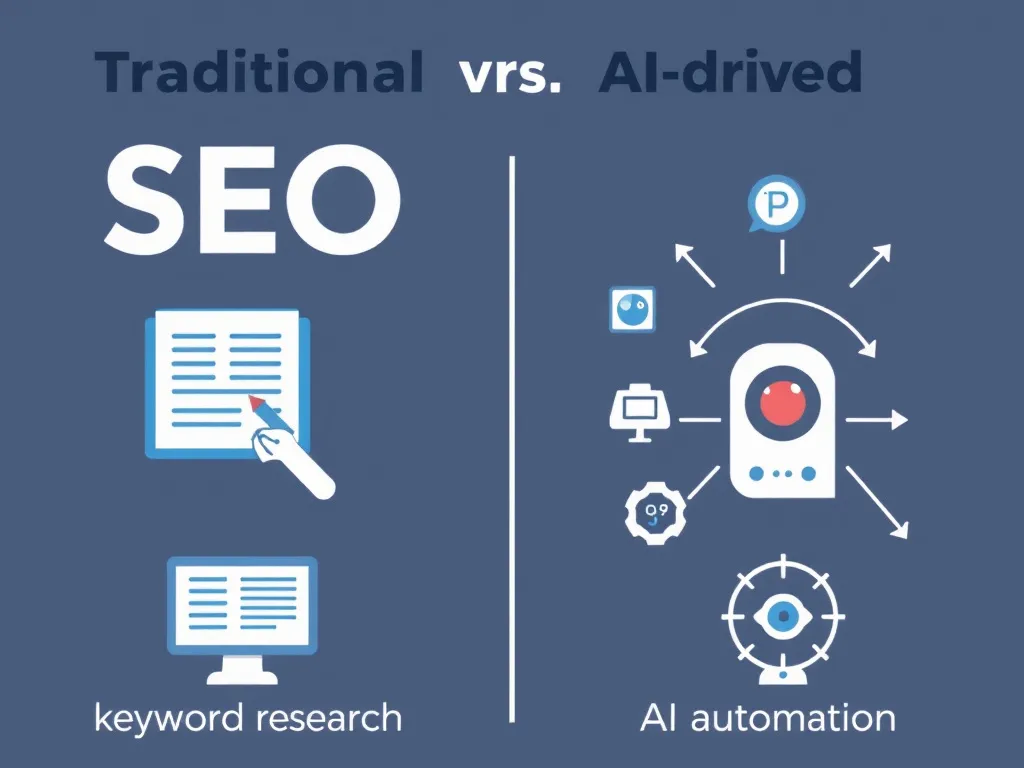
| Aspect | Traditional SEO | AI-Driven SEO |
|---|---|---|
| Keyword Research | Manual research, spreadsheets, and periodic updates. | Keyword clustering, intent analysis, topic gaps, and faster prioritization. |
| Content Planning | Manual briefs and slower content calendars. | AI-assisted briefs, topic clusters, questions, headings, and internal link suggestions. |
| Technical SEO | Periodic audits and manual issue tracking. | Continuous checks for indexing, crawl errors, speed, redirects, and structured data issues. |
| Optimization | Manual updates based on rankings and reports. | Ongoing improvement based on impressions, CTR, content decay, and AI-driven recommendations. |
| Workflow | Often disconnected across tools and teams. | More connected workflows from research to publishing and monitoring. |
A strong AI SEO workflow connects research, technical fixes, content planning, publishing, internal linking, and performance monitoring.
How Businesses Should Adapt to AI Search
Businesses should not abandon SEO. They should modernize it. The goal is to build a system that works for traditional Google visibility and AI-driven discovery.
1. Fix technical SEO first
Make sure important pages are crawlable, indexable, fast, secure, mobile-friendly, and internally linked. If your technical foundation is weak, AI search optimization will also be weak.
2. Build topic clusters
Create hub pages for important topics and connect supporting articles through contextual internal links. This helps users and search engines understand your depth.
3. Add structured data
Use schema markup to clarify articles, FAQs, breadcrumbs, organization details, authors, products, and software pages. Learn more in the guide to structured data and schema markup for SEO.
4. Write clear answer-focused content
Add direct answers, definitions, examples, steps, comparison tables, and FAQs. This helps both users and AI systems understand the value of the page.
5. Strengthen entity clarity
Use consistent language for your brand, product, authors, topics, and services. Add clear About, Contact, and product pages where relevant.
6. Use AI to support workflow, not replace judgment
AI can help with research, briefs, audits, internal links, and monitoring. Human review is still important for accuracy, positioning, creativity, and business strategy.
7. Automate repetitive SEO tasks
Many recurring SEO tasks can be automated, including audits, reports, keyword clustering, content refresh suggestions, and internal linking reviews. This is especially useful for small businesses that cannot hire a full SEO team immediately. Read more about SEO automation for small businesses.
Where Hunnt AI Fits
Hunnt AI is designed for teams that want to adapt to the new search landscape without treating SEO as disconnected tasks.
Instead of only generating content or showing reports, Hunnt AI helps connect SEO research, technical SEO insights, content planning, optimization, publishing support, internal linking, and performance monitoring into one practical workflow.
This is important because AI search visibility depends on a connected system:
- Technical SEO so pages can be discovered and indexed.
- Structured data so machines can understand content clearly.
- Helpful content so users get real answers.
- Topic clusters so the website builds authority.
- Internal links so related pages support each other.
- Monitoring so teams improve based on real data.
Modern SEO is not one tactic. It is an operating system for visibility across traditional search and AI-driven discovery.
Common Mistakes Businesses Make in the AI Search Era
As AI changes search behavior, many businesses react in the wrong way. Avoid these common mistakes:
- Assuming SEO is dead: SEO fundamentals still matter and are the foundation for AI visibility.
- Publishing generic AI content: AI-assisted content needs human expertise, examples, and quality control.
- Ignoring technical SEO: AI search cannot help pages that are not crawlable or indexable.
- Skipping structured data: Schema helps machines understand your content more clearly.
- Creating isolated posts: Topic clusters and internal links are more important than random publishing.
- Optimizing only for keywords: Modern SEO also needs entities, intent, clarity, and usefulness.
- Not measuring after updates: Search visibility changes over time, so monitoring is essential.
AI Search and SEO FAQs
Is SEO dead?
No. SEO is not dead. It is evolving. Traditional SEO fundamentals such as technical SEO, helpful content, internal linking, indexing, and authority still matter, but businesses now need to adapt to AI search and generative answer experiences.
Is traditional SEO still important?
Yes. Traditional SEO is still important because search engines still need to crawl, index, understand, and rank pages. The difference is that modern SEO now also needs AI search optimization, GEO, structured content, and stronger entity signals.
How is AI changing SEO?
AI is changing SEO by improving keyword research, content briefs, technical audits, internal linking, content optimization, and performance monitoring. It is also changing search behavior through AI Overviews, conversational answers, and answer engines.
What is AI search optimization?
AI search optimization is the process of making content easier for AI systems and answer engines to understand, summarize, and cite. It includes clear answers, structured data, entity clarity, technical SEO, topical authority, and helpful content.
What is GEO in SEO?
GEO stands for Generative Engine Optimization. It focuses on optimizing content for AI-generated answers and generative search experiences such as Google AI Overviews, ChatGPT-style discovery, and Perplexity-style answer engines.
Will AI replace SEO specialists?
AI will not fully replace SEO specialists. It can automate research, audits, briefs, reporting, and monitoring, but human judgment is still needed for strategy, accuracy, brand positioning, creativity, and business decisions.
How should businesses prepare for AI search?
Businesses should fix technical SEO, create helpful content, add structured data, build topic clusters, improve internal linking, clarify entities, automate repetitive tasks, and monitor performance continuously.
Conclusion: SEO Is Not Dead, It Is Becoming More Intelligent
Traditional SEO is not dead. But the old version of SEO that depended on keyword stuffing, generic content, isolated articles, and manual guesswork is becoming less effective.
Modern SEO is more technical, more structured, more entity-driven, and more connected to AI search. Businesses that adapt will have a stronger chance of appearing in traditional search results, AI Overviews, answer engines, and conversational discovery experiences.
The future of SEO is a connected system: technical SEO, helpful content, structured data, internal links, topic clusters, GEO, AI SEO workflows, and smart automation.
To continue adapting your strategy, explore the AI SEO Hub, read the guide to Generative Engine Optimization, or see how Hunnt AI helps teams improve SEO workflows.